


MBC Shahid
MBC Group
I spent time with MBC Shahid as an entertainment app, and my overall impression is that it works best as a broad Arabic-focused viewing hub rather than as a simple replacement for every streaming service. Its appeal comes from bringing series, films, live television, sports, and MBC’s own programming into one place. That range is useful when my viewing mood changes quickly, but it also means the experience depends heavily on what I want to watch on a particular day.
The app is developed by MBC Group and is available free of charge. It is rated for Everyone, which makes it approachable for households with different age groups, although parents should still pay attention to the specific program being selected. The service has passed over 100 million installs, so it is clearly not a niche player. At the same time, its average score sits at 3.2 from around 776 thousand ratings, a sign that the large audience has had mixed experiences rather than universally smooth ones.
How the service feels in everyday use
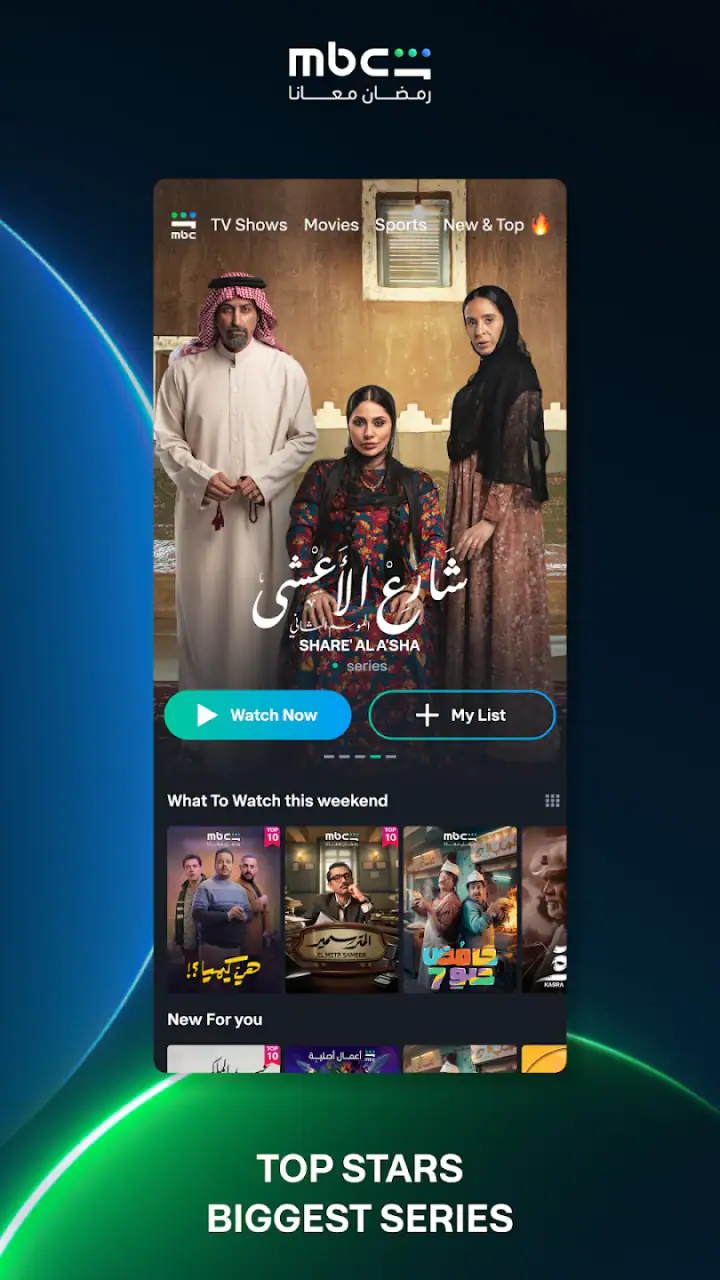
The first thing I noticed is that Shahid is designed around discovery. Instead of opening to one narrow type of content, I can move between Arabic originals, general series, movies, live channels, and sports. That makes it particularly convenient when I am not arriving with a precise title in mind. I can browse for something familiar, check what is live, or switch from an on-demand show to a current event without changing apps.
That flexibility is also the app’s main challenge. A service with several viewing categories can feel busier than a focused movie or series platform. If I already know that I want one specific international title, a specialist streaming service may get me there faster. Shahid makes more sense when Arabic programming and MBC-related content are central to my viewing habits, or when I want several kinds of entertainment gathered under one account.
In practical terms, I would use it in two different ways. For planned viewing, I would search for a series or film and settle into an episode. For casual viewing, I would browse the home screen and consider live television or sports. Those are distinct habits, and the app’s value changes depending on which one describes me. A person who mainly watches live programming may appreciate the wider channel-oriented experience, while someone who only wants a carefully curated film library may find the broader layout less efficient.
Related News

Why WhatsApp Messenger Still Makes Everyday Communication Feel Easy

Jurassic World: The Game Is the Better Dino Tycoon for Strategic Players

Threads in Real Life: Who Should Join, Lurk, or Leave

How SHEIN Turned Shopping Into an Endless Content Feed

How to Make Fortnite Feel Smarter on Mobile

Should You Switch to Microsoft Outlook on Mobile?
What the free starting point really means
The free price is important because it lowers the barrier to trying the service. I can install it, explore its catalog, and decide whether the available selection suits my household before committing money. That is a meaningful advantage over services that ask for payment before I can judge whether their programming is relevant to me.
However, “free” should not be read as a promise that every part of the service is included without conditions. The app contains in-app purchases ranging from $0.99 to $304.99 per item. That wide range tells me to check the details of any offer carefully instead of assuming that installation equals complete access. The sensible approach is to treat the free version as an opportunity to evaluate the service, then inspect the exact purchase screen before paying for anything.
I also would not judge the value of a paid option by the number of content categories alone. A subscription or individual purchase is worthwhile only if it unlocks programming I genuinely expect to watch. If my interest is limited to occasional free viewing, paying may not improve my experience enough. If I regularly follow Arabic originals, live television, or sports through the app, the calculation becomes more favorable because the service can replace several separate viewing habits.
Gallery
That distinction is especially useful for families. One person may care about series, another may look for films, and someone else may want live sports. In that situation, a single service with varied programming can be more convenient than maintaining several narrow apps. But convenience has a limit: if only one member of the household uses Shahid and their preferred shows are available elsewhere, the broader catalog may not justify an additional purchase.
Finding useful content without wasting time
My strongest practical tip is to decide what kind of session I am starting before opening the app. If I want a particular show, I go straight to search rather than scrolling through recommendations. If I want background entertainment, I check live options first. If I am choosing a family film, I browse deliberately and confirm the title’s suitability instead of relying only on the Everyone age rating for the app itself.
That small change makes the service feel less overwhelming. The home screen is useful for discovering something new, but endless browsing can make a large catalog feel smaller because I spend more time choosing than watching. Shahid is better when I use discovery as a tool, not as the entire viewing plan.
Another useful workflow is to separate “watch now” decisions from “maybe later” decisions. When I find a promising series, I avoid opening several episodes immediately just to test them. I first check whether the premise, language, and format fit the time I have available. This matters with serialized content: starting a long show during a short break often leads to a frustrating stop halfway through an episode.
For live content, timing matters more than it does with on-demand viewing. I would open the live section when I specifically want something happening now, rather than treating it like a normal catalog. That prevents me from judging the app unfairly when a live schedule does not match my free time. The live component adds variety, but it is naturally less flexible than a film or recorded episode.
Where Shahid stands beside familiar alternatives
Compared with a traditional television setup, Shahid offers more control over when I begin a program and gives me a single place to explore several entertainment formats. Compared with a focused streaming app, it is less specialized but potentially more useful for viewers whose interests cross between Arabic series, films, live channels, and sports.
That comparison reveals the central trade-off. A specialist service may feel cleaner when I want a particular kind of catalog, while Shahid is more compelling when I want breadth with an Arabic emphasis. I would not choose it solely because it has many categories. I would choose it because those categories match my actual routine.
It is also worth separating brand familiarity from practical value. MBC Group’s name may make the app immediately recognizable, but recognition does not guarantee that every program will suit me. I would still judge the service by the titles I can access, the viewing habits it supports, and the clarity of the purchase options. The app earns its place when it reduces the need to switch between services, not simply because it comes from a well-known media group.
Small decisions that improve the experience
One non-obvious advantage of a mixed entertainment app is that it can serve different moods without forcing me to make a long-term decision about one genre. On a quiet evening I might choose an episode; on a weekend I might look for a film; during a major event I might open sports or live television. I find that useful because the app remains relevant even when my routine changes.
The drawback is that breadth can hide the difference between “available to explore” and “worth paying for.” I recommend treating the free access as a trial of relevance, not merely a trial of interface design. Spend enough time checking whether the Arabic originals, films, and live offerings fit your real preferences. A polished browsing experience is not valuable if the actual programs you want sit behind a purchase you do not intend to make.
I would also keep the app’s current software requirements in mind before installing it. The current version is 8.0.0 and requires Android 8.0 or later. That is straightforward for many recent devices, but anyone using older hardware should check compatibility first. There is little benefit in planning a viewing routine around an app that the phone cannot run comfortably.
Because the app has a large audience but only a 3.2 average rating, I would approach it with realistic expectations. The scale suggests strong demand, while the rating suggests that smoothness and satisfaction are not identical for everyone. My advice is to test it on the device and connection I actually plan to use, browse the content that matters to me, and inspect the purchase path before making a commitment. That is more useful than assuming either the high install count or the middling rating tells the whole story.
Who is likely to get the most from it
I think Shahid is a strong candidate for viewers who actively seek Arabic entertainment and want more than one format in the same app. It is also attractive to households where different people rotate between series, films, live television, and sports. The free entry point makes it easy to see whether that variety is genuinely useful before spending money.
It can also suit someone who has moved away from a fixed television schedule but still enjoys the feeling of checking what is on live channels. The combination of scheduled and on-demand viewing gives me two different ways to use the service. I can plan a show, or I can let the current schedule make the decision for me.
For example, imagine a family settling in after dinner. One person wants an Arabic series, another would rather watch a film, and a third is checking whether a live sports event is available. Shahid may reduce the need to jump between unrelated apps. The value in that moment is not just the number of titles; it is the convenience of keeping several viewing paths together.
On the other hand, I would skip it if my main requirement is a highly specialized catalog outside its apparent Arabic and MBC-centered strengths. I would also hesitate if I dislike browsing mixed content categories or if I only watch a few titles each year. In those cases, a narrower service, free television option, or individual rental may be a better fit, depending on the content I want and the payment terms shown at the time.
Parents should see the Everyone rating as a statement about the app’s general audience suitability, not a guarantee that every movie, series, live broadcast, or sports program is designed for children. I would choose content together with younger viewers and use the title information available in the app before handing over viewing control. That extra step is sensible for any service that combines many formats and audiences.
My final decision on the value
I recommend trying Shahid when its Arabic programming, MBC content, live television, and sports selection line up with your normal viewing. The free starting point gives it a practical advantage: I can investigate the catalog before deciding whether any paid access is worthwhile. That makes the app easier to recommend than a service whose value depends entirely on an immediate purchase.
I would not recommend paying automatically just because the app covers many entertainment categories. The in-app purchase range is broad, so I would read each offer carefully and connect the cost to specific programs I expect to watch. Free access can be enough for occasional users, while frequent viewers may find greater value in paid access if it consistently supports their preferred content.
My verdict is therefore positive but selective. Shahid is not the universal answer for every streaming need, and its mixed rating warns me not to promise a perfect experience. Still, for the right viewer, it combines enough viewing choices to become a useful everyday destination rather than a one-purpose app. I would install it, explore it without rushing into a purchase, and keep it only if the actual catalog fits my routine. The best reason to choose Shahid is not its size, but how naturally its Arabic-focused mix fits the way you watch.
FAQs for MBC Shahid
What is MBC Shahid, and what content does it offer?
MBC Shahid is a popular streaming platform that offers a wide variety of Arabic TV shows, movies, series, and exclusive content. It features both classic and contemporary entertainment, catering to diverse tastes. Additionally, the platform provides live TV streaming of various MBC channels, making it a comprehensive choice for fans of Arabic media.
Is MBC Shahid available on both Android and iOS devices?
Yes, MBC Shahid is available for download on both Android and iOS devices. Users can enjoy seamless streaming on smartphones and tablets, ensuring accessibility on the go. The app is designed to offer a user-friendly experience with features tailored to each platform, providing high-quality streaming and easy navigation.
Do I need a subscription to access content on MBC Shahid?
MBC Shahid offers both free and premium content. While some shows and movies are available for free, a subscription is required to access Shahid VIP, which includes exclusive content, ad-free streaming, and early access to some series. Subscription plans vary, allowing users to choose based on their viewing preferences.
What are the main features of the MBC Shahid app?
The MBC Shahid app boasts several features, including a vast library of Arabic content, live TV streaming, personalized recommendations, and offline viewing. Users can create watchlists, resume watching across devices, and enjoy high-definition streaming. The app's interface is intuitive, making it easy to discover new shows and movies.
How can I troubleshoot common issues with MBC Shahid?
If you encounter issues with MBC Shahid, common solutions include ensuring a stable internet connection, updating the app to the latest version, and restarting your device. Clearing the app cache or data might also resolve performance issues. For persistent problems, contacting MBC Shahid’s customer support is recommended for further assistance.
Pros
- Extensive library of Arabic content.
- User-friendly interface for easy navigation.
- High-quality streaming with minimal buffering.
- Available on multiple devices and platforms.
- Includes both free and premium content.
Cons
- Limited content for non-Arabic speakers.
- Ads can be intrusive in the free version.
- Some features require premium subscription.
- Geographic restrictions on certain content.
- Occasional app crashes reported by users.


